


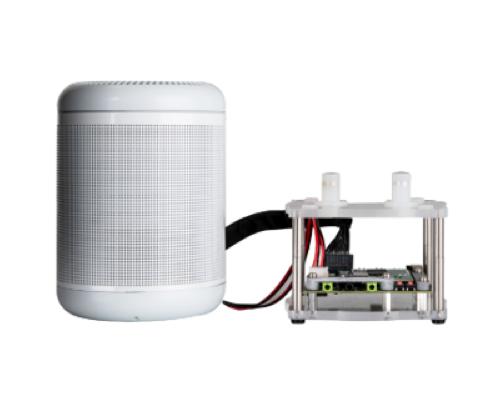
The Qualcomm QCS405 is a 64-bit application processor in Qualcomm’s QCS400 series, designed primarily for smart speakers, soundbars, home theater systems, smart displays, and voice-controlled IoT devices. Its main strengths are audio signal processing, always-on voice detection, and integrated connectivity.
Key specifications
CPU
Quad-core
Arm Cortex-A53, up to 1.4 GHz
GPU
Adreno 306
Up to 600 MHz
Audio / AI DSP
2× Hexagon
QDSP6 v66
Operating system
Linux
Board-specific software support
Specifications:
Connectivity and hardware features
| Feature | Details |
|---|---|
| Memory | Depends on module; examples use 1 GB LPDDR3 |
| Storage | Module-dependent; examples use 8 GB eMMC |
| Wi-Fi | 802.11a/b/g/n/ac, depending on wireless configuration |
| Bluetooth | Bluetooth 5.0 on common modules |
| Audio interfaces | I²S, digital microphones, audio DSP interfaces |
| Display | MIPI DSI and HDMI capability on supported implementations |
| USB | USB 3.0 and USB 2.0, depending on board |
| Additional interfaces | GPIO, UART, SPI, I²C and other board-dependent interfaces |
These are platform and module examples, not a guarantee that every interface is available on every QCS405 design.
What makes QCS405 useful?
- Smart audio: supports advanced audio processing, including Dolby Atmos and DTS:X capabilities in supported product implementations.
- Voice assistants: supports low-power keyword detection, local speech recognition workflows, and far-field microphone processing.
- Noise and echo cancellation: designed for multi-microphone beamforming and acoustic echo cancellation.
QCS405 vs. QCS6490
Since you previously asked about QCS6490, here’s the practical difference.
| Category | QCS405 | QCS6490 |
|---|---|---|
| Primary purpose | Smart audio and voice interfaces | Industrial IoT and edge AI |
| CPU | 4× Cortex-A53, up to 1.4 GHz | 8-core Kryo 670 |
| Graphics | Adreno 306 | Adreno 643 |
| AI focus | Voice detection and audio DSP | Broader on-device AI and computer vision |
| Typical applications | Speakers, soundbars, home hubs | Robotics, vision systems, embedded computers |
Bottom line: QCS405 is an audio-focused embedded processor, while QCS6490 is a substantially more capable platform for general-purpose computing and demanding AI workloads.
One important lifecycle note: Qualcomm currently labels QCS405 as “Not Recommended For New Designs.” For a new product, check current software support and component availability before committing to it.